Black and white house icon with roof, chimney, and round window.

Shingles vs Metal Roofing for Repairs: Which Holds Up Better in Texas Weather

July 21, 2026

Most homeowners in Royse City, Rockwall, and the surrounding North Texas communities start thinking about roofing materials after a storm. A hail event rolls through, an adjuster shows up, and suddenly there is a decision to make that nobody fully prepared for. Repair with the same shingles that were already there? Or is this the moment to switch to metal?


It is a reasonable question. And it deserves a straight answer, not a sales pitch toward whichever option costs more.


Swift Roofing works with homeowners across Rockwall County, Hunt County, and the wider North Texas area every week. We see both materials up close after storms, during inspections, and after they have been on a roof for twenty years in Texas heat. This is the honest comparison he gives homeowners before they decide.

Why This Decision Is Different in North Texas

The shingles vs metal conversation that applies to a homeowner in Seattle or Chicago does not apply the same way in Royse City, Rockwall, Fate, or Greenville. North Texas puts roofing materials through a specific combination of stressors that shorten lifespans and change the math on both options.


The NOAA National Weather Service Fort Worth tracks severe weather events across the North Texas region, and Rockwall and Hunt Counties appear consistently in hail and wind damage reports. In April 2026 alone, NOAA's Fort Worth office documented 226 reports of large hail across the region, with significant events confirmed in Rockwall County. That kind of frequency is not unusual for this part of Texas. It is the pattern.


Beyond hail, North Texas adds three additional stressors that matter when comparing materials:

Weather factor What it does to asphalt shingles What it does to metal roofing
Summer heat exceeding 100 degrees Surface temps reach 150 to 170 degrees, accelerating granule loss and asphalt breakdown Reflects solar heat rather than absorbing it, running significantly cooler at the surface
Intense UV exposure year-round Petroleum-based asphalt oxidizes and becomes brittle over time Metal does not degrade under UV the way asphalt does
Temperature swings between seasons Repeated expansion and contraction stresses shingle bonds and causes curling or cracking Standing seam systems are designed with floating panels to accommodate thermal movement
Hail frequency across Rockwall and Hunt Counties Granule loss occurs even when hail does not visibly crack a shingle, shortening effective lifespan Metal takes impact differently, typically showing cosmetic denting rather than material loss

Our experience matches the data. A roof that might last thirty years in a moderate climate often shows meaningful wear in North Texas by year fifteen or eighteen, particularly if it has taken one or two hail events along the way.

Asphalt Shingles: What They Are and How They Perform Here

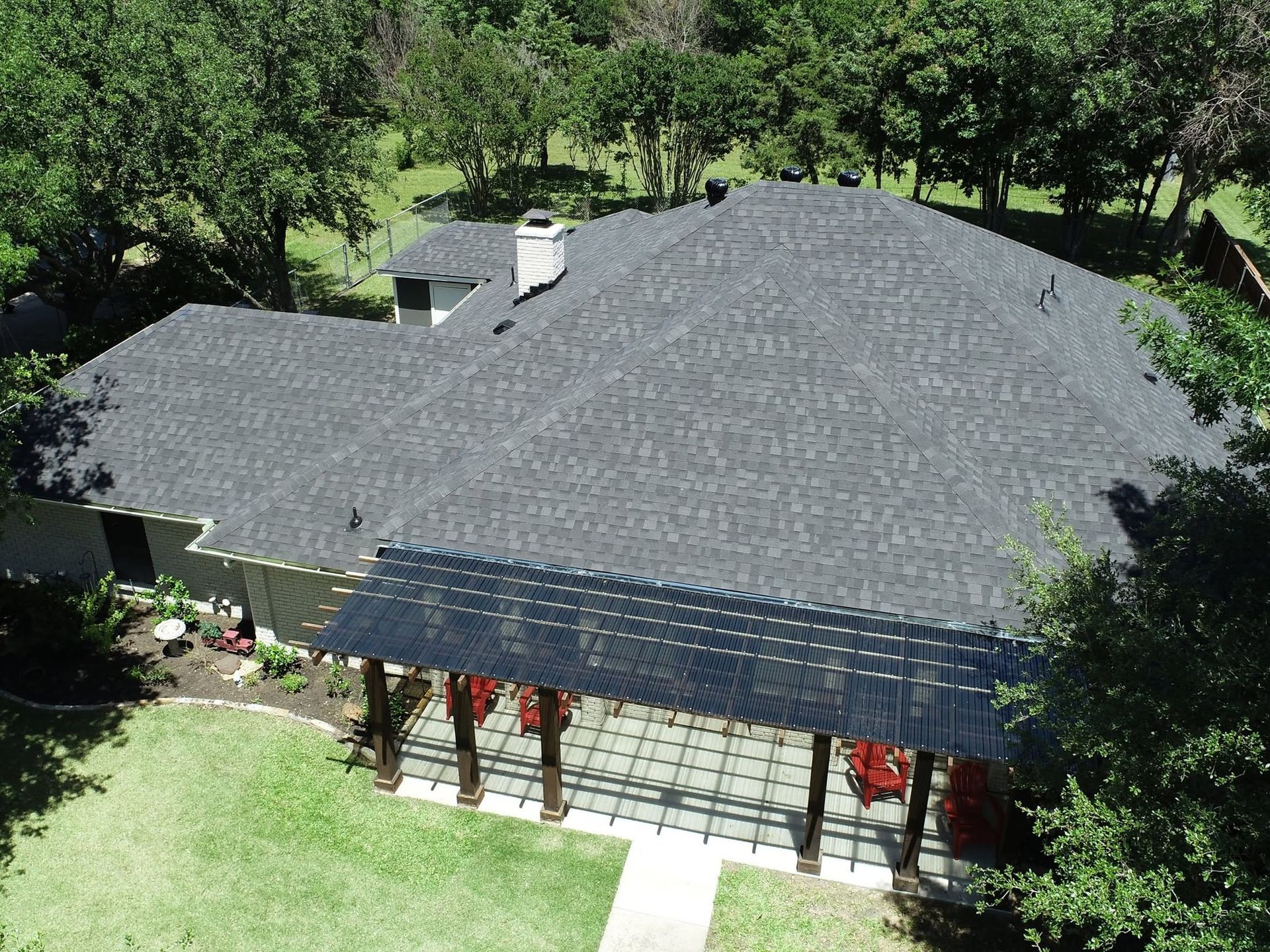
Asphalt shingles cover the majority of homes in Royse City and across North Texas. They are familiar, widely installed, and available at a range of quality and price points. Most homeowners after a storm replacement are looking at architectural shingles, the thicker laminated version that replaced older three-tab designs.


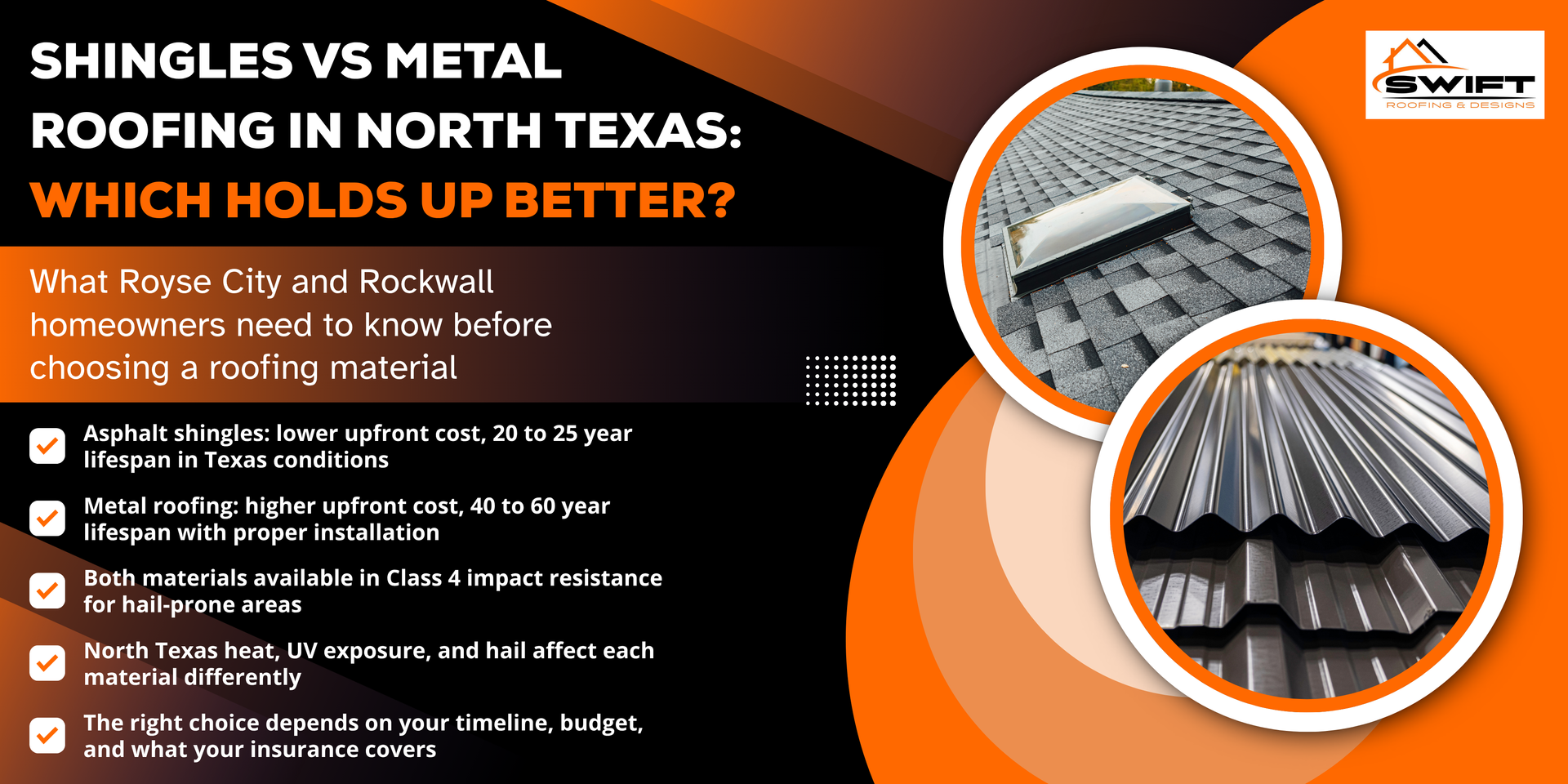
In North Texas conditions, architectural shingles from quality manufacturers realistically last fifteen to twenty-five years. That range matters because it is not just about the product. Attic ventilation, installation quality, and the number of hail events the roof has absorbed all affect where a specific roof lands within that window.


The most important distinction when choosing asphalt shingles for a North Texas home is whether the product carries a Class 4 impact resistance rating. Class 4 is the highest rating under the UL 2218 standard, earned by withstanding a two-inch steel ball dropped from twenty feet. For homeowners in Royse City, Rockwall, McKinney, Sachse, and surrounding communities, Class 4 rated shingles are not a luxury option. They are the appropriate baseline given how frequently hail events occur in this part of Texas.


Texas insurance carriers recognize this. Many carriers offer premium discounts in the range of five to fifteen percent for homeowners who install Class 4 impact-rated shingles. That discount, compounded over the life of the roof, represents real money.


What asphalt shingles make sense for:


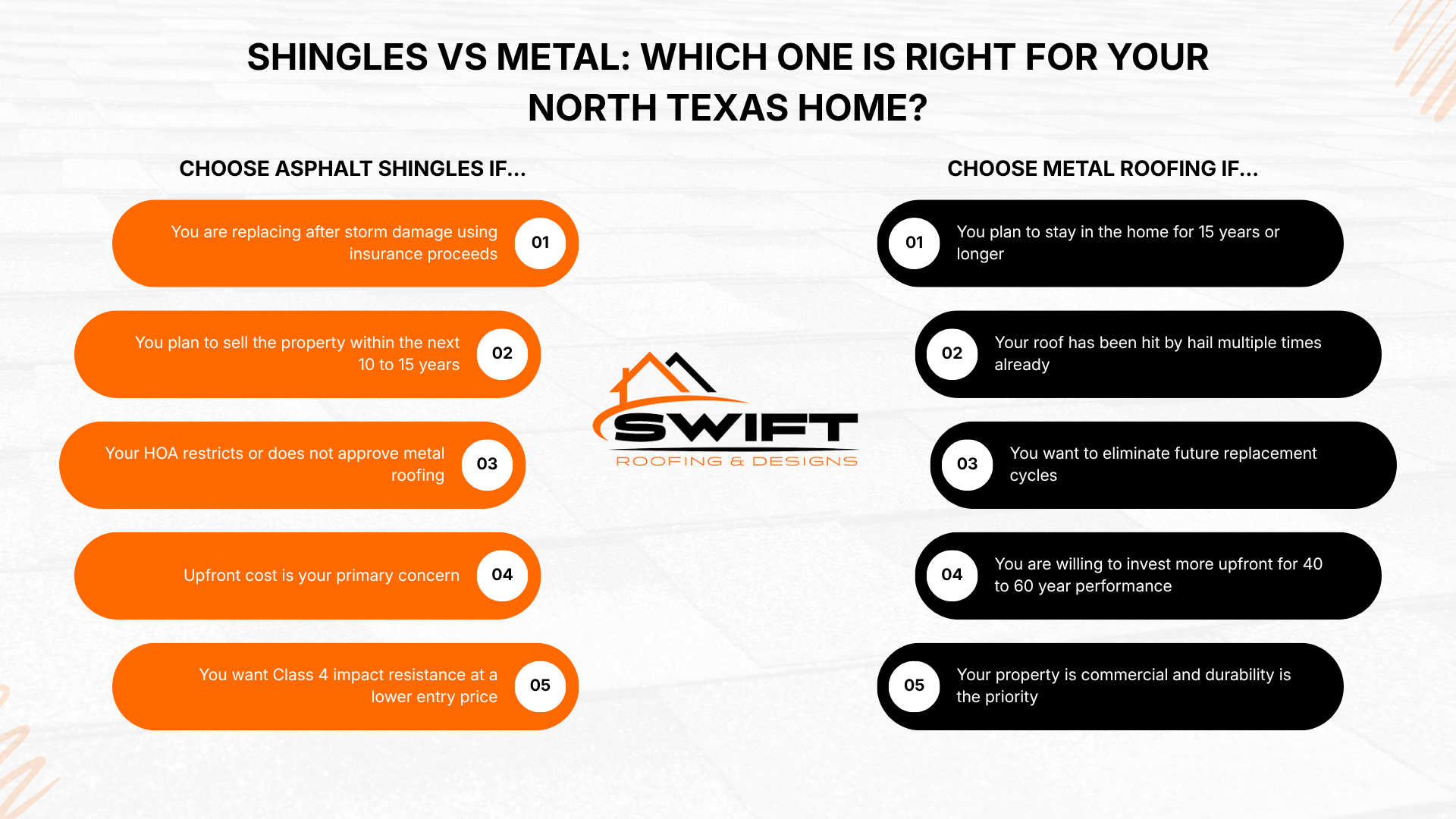
  • Homeowners replacing after hail damage who want to use insurance proceeds efficiently
  • Homeowners who plan to sell the property within the next ten to fifteen years
  • Properties in HOA communities where metal roofing is restricted or not approved
  • Budget-conscious situations where upfront cost is the primary constraint

Metal Roofing: What It Is and How It Performs Here

Metal roofing in the residential context typically means either standing seam panels or stone-coated steel. Standing seam is the more common premium option. It uses long panels that run from ridge to eave with concealed fasteners and interlocked seams, creating a continuous surface rather than individual overlapping pieces.


In North Texas conditions, a properly installed standing seam metal roof lasts forty to sixty years or more. That lifespan advantage is more meaningful here than in many other markets precisely because of the heat, UV, and hail patterns described above. A roof that survives two or three major hail events over forty years without losing waterproofing integrity is a meaningfully different product than one that accumulates granule loss with each event.


The tradeoff is upfront cost. Metal roofing typically runs two to three times the installed cost of asphalt shingles for the same home. For a typical North Texas residential roof, that means comparing a shingle replacement in the fifteen to twenty-five thousand dollar range against a metal installation in the thirty to sixty thousand dollar range, depending on roof complexity, pitch, and material selection.


When the math is run over a full ownership period, metal's case improves. A homeowner who stays in their house for thirty-plus years, replacing asphalt shingles once or twice during that period, often ends up spending more over time than the homeowner who installs metal once. That long-term calculation does not apply to everyone, which is why the right answer depends on individual circumstances.


One nuance worth understanding: some Texas insurance carriers treat cosmetic hail damage to metal differently than functional damage to shingles. Metal panels that dent under hail typically do not leak, but some carriers exclude cosmetic-only damage from their coverage on metal roofs. We review this detail with every homeowner who is considering metal so there are no surprises at the next claim.


What metal roofing makes sense for:


  • Homeowners planning to stay in the property for fifteen years or longer
  • Properties that have absorbed two or more significant hail events already
  • Homeowners who want to eliminate or reduce future replacement cycles
  • Commercial property owners prioritizing long-term durability and lower maintenance

How Hail Affects Each Material Differently

Hail is the defining weather event for roofing decisions in Royse City, Rockwall, and North Texas broadly. Understanding how each material responds to hail helps homeowners make more informed decisions before and after a storm.


Asphalt shingles and hail: A hail impact on an asphalt shingle displaces granules from the surface. Those granules protect the underlying asphalt from UV degradation. When they are lost, the asphalt oxidizes faster. A single major hail event may not crack a shingle or cause an immediate leak, but the granule loss it causes accelerates the aging process. This is why insurance carriers in Texas typically cover replacement after significant hail events even when the shingles are not visibly broken. The functional damage is real even when it is not obvious from the ground.


Class 4 impact-rated asphalt shingles are specifically engineered to minimize granule displacement and resist cracking under hail impact. They are measurably better than standard architectural shingles in hail events and the appropriate choice for North Texas homes.


Metal roofing and hail: Hail impacts on metal panels do not displace material or compromise waterproofing in the way they do on asphalt. A panel that dents under a golf-ball-sized hail impact still sheds water effectively. The damage is cosmetic rather than functional. This is one of metal's clearest performance advantages in a market like North Texas.


The caveat is the insurance consideration noted earlier. Homeowners with metal roofs should review their policy language with their carrier to understand how cosmetic hail damage is treated before a storm occurs rather than after.


For a more detailed look at how to evaluate storm damage and what to do immediately after a hail event, see Swift Roofing's storm damage inspection page.

The Insurance Claim Connection

Most homeowners in North Texas face this decision in the context of an insurance claim rather than a planned upgrade. Understanding how each material affects that process is part of making the right choice.


Asphalt shingles and insurance: Most carriers in Texas cover replacement with comparable materials after a qualifying hail or wind event. Class 4 impact-rated shingles are covered under standard replacement claims and qualify for premium discounts with most major carriers. The replacement process with asphalt shingles is well understood by adjusters and straightforward from a documentation standpoint.


Metal roofing and insurance: Upgrading from asphalt to metal at the time of an insurance claim is possible, but the homeowner typically pays the difference between the insurance payout for shingle replacement and the cost of metal installation. That out-of-pocket gap can be significant. Some homeowners decide the long-term value justifies that investment. Others choose to replace with Class 4 shingles using the insurance proceeds and revisit the metal conversation at a later date.


We walk through insurance claim documentation, material options, and the cost difference with every homeowner before any work begins. Swift Roofing provides honest assessments of what the claim will cover and what an upgrade to metal would cost so homeowners can make the decision that fits their situation. For guidance on navigating the insurance process, Swift Roofing also offers support through the roof inspection and insurance assessment process.

Should You Repair or Replace?

The shingles vs metal question is secondary to a more fundamental one: does this roof need to be repaired or replaced?


A partial repair with the same material is sometimes the right answer. A full replacement with an upgraded material is sometimes the right answer. The decision depends on the age of the existing roof, the extent of the damage, and what the inspection reveals.

Situation What Swift Roofing typically recommends
Storm damage on a roof under 10 years old with isolated damage Repair with matching material
Storm damage on a roof 15 to 20 years old across a large area Replacement evaluation; full replacement often makes more sense than repair
Multiple hail events on a roof that is approaching end of life Replacement, with material upgrade worth discussing
Isolated flashing or penetration failure with no storm involvement Targeted repair regardless of material
A homeowner planning to sell within 5 years Shingle replacement to match buyer expectations and neighborhood norms
A homeowner staying long-term after multiple storm events Full assessment of metal vs Class 4 shingles based on budget and insurance

If you are not sure where your roof falls in this framework, the right starting point is a professional inspection. Swift Roofing offers free roof inspections throughout Royse City, Rockwall, Fate, Greenville, Heath, Terrell, Caddo Mills, Quinlan, Forney, and surrounding communities.

Frequently Asked Questions

  • How long do asphalt shingles actually last in North Texas?

    In North Texas conditions, architectural asphalt shingles from quality manufacturers realistically last fifteen to twenty-five years. The variance depends on attic ventilation, installation quality, and how many hail events the roof absorbs over its life. Class 4 impact-rated shingles perform at the higher end of that range. Standard three-tab shingles in this climate often need replacement in fifteen years or fewer.

  • Does metal roofing make noise during rain or hail in Texas?

    With proper installation over solid decking and underlayment, a standing seam metal roof is not significantly louder than an asphalt roof during rain. Hail impacts on metal are audible during the storm but do not produce the prolonged noise some homeowners expect. The noise concern is more common with older or thinner metal panel systems than with modern residential standing seam products.

  • Will my insurance pay for metal roofing if I currently have shingles?

    Insurance claims are typically paid based on the cost to replace with a comparable material. If you currently have asphalt shingles, your carrier will generally pay out based on shingle replacement cost. Upgrading to metal is allowed in most cases, but the homeowner covers the cost difference between the shingle payout and the metal installation cost. We review this with every homeowner before a decision is made.

  • What is a Class 4 impact rating and do I need it in Royse City?

    Class 4 is the highest impact resistance rating for roofing materials under the UL 2218 standard. For Royse City, Rockwall, McKinney, Sachse, and the broader North Texas area, Class 4 is the appropriate specification given the frequency of significant hail events in this region. Many Texas insurance carriers offer premium discounts for Class 4 installations. Swift Roofing recommends Class 4 rated materials on every North Texas roof replacement.

  • Can I mix materials, for example metal on one section and shingles on the rest?

    In some cases, hybrid approaches work architecturally, such as metal on lower-pitch sections or accent rooflines with shingles on the main field. It is not the norm for residential roofs in North Texas and requires careful flashing and transition work to do correctly. We evaluate the specific roof before recommending any hybrid approach.

  • How do I know if my roof needs replacement or just repair after a storm?

    The starting point is a professional inspection by someone who is not financially motivated to recommend one outcome over another. Swift Roofing's inspections are free, thorough, and documented with photos. We personally review findings with homeowners and give a straight recommendation on repair vs replacement before any paperwork is signed. Call (469) 964-7431 to schedule.

If you have questions about which roofing material is right for your home in Royse City, Rockwall, Fate, Greenville, Heath, Terrell, Caddo Mills, Quinlan, Forney, or anywhere in North Texas, Swift Roofing is the call to make. We answer personally, review the roof honestly, and gives you the information you need to make the right decision for your home and your budget.


Schedule a Free Roof Inspection

Storm Damage and Hail Repair

Roof Repair Services

Financing Options

Contact Swift Roofing


Request a Roofing Quote

Blog Form


More Posts Like This:

Aerial view of a large gray-roofed mansion surrounded by green lawns and landscaped gardens.
July 14, 2026
A visual inspection sees what is on the surface. An infrared inspection sees what is hiding underneath. Swift Roofing explains the difference, when each method applies, and what North Texas homeowners need to know before scheduling an inspection.
Aerial view of a gray-roofed suburban house with a driveway and surrounding lawn.
July 9, 2026
Choosing the wrong commercial roofing material in North Texas costs property owners thousands in premature repairs. Swift Roofing breaks down the 6 most durable options, what each one costs, and which one is right for your building.
Aerial view of a brick house with a gray shingle roof and surrounding greenery.
June 30, 2026
Not every aging roof in Royse City TX needs full replacement. Swift Roofing & Designs breaks down when restoration extends your roof's life and when replacement is the only answer.
Show More
Black outline of a house with a slanted roof and chimney.

Choose Swift Roofing & Designs for Top Quality Roofing

Need a reliable roofer? We've helped countless clients protect their homes while saving time and money, and we’re ready to help you next.

Aerial view of a large gray-roofed mansion surrounded by green lawns and landscaped gardens.
July 14, 2026
A visual inspection sees what is on the surface. An infrared inspection sees what is hiding underneath. Swift Roofing explains the difference, when each method applies, and what North Texas homeowners need to know before scheduling an inspection.
Aerial view of a gray-roofed suburban house with a driveway and surrounding lawn.
July 9, 2026
Choosing the wrong commercial roofing material in North Texas costs property owners thousands in premature repairs. Swift Roofing breaks down the 6 most durable options, what each one costs, and which one is right for your building.
Aerial view of a brick house with a gray shingle roof and surrounding greenery.
June 30, 2026
Not every aging roof in Royse City TX needs full replacement. Swift Roofing & Designs breaks down when restoration extends your roof's life and when replacement is the only answer.
Aerial view of a large gray-shingled house with multiple gables and a beige exterior.
June 23, 2026
From hail damage to failed flashing, Royse City TX homeowners face the same five roof repairs year after year. Swift Roofing & Designs breaks down each one, what causes it, and how to catch it before it becomes a replacement.
Aerial view of a house with a dark roof surrounded by trees and a green yard
June 16, 2026
Spring debris left in your gutters becomes a liability when Royse City summer storms arrive. Swift Roofing & Designs explains what is at stake and what to do about it before the rain season peaks.
Aerial view of a dark-roofed house with a driveway, patio furniture, and a parked car beside a road
June 9, 2026
Learn the warning signs of heat damage on Royse City roofs, from curling shingles to granule loss. Protect your home with expert roofing insights.
Workers installing blue roofing panels on a house roof during construction or repair.
June 4, 2026
June is the most important roof inspection window in North Texas. Swift Roofing's summer checklist helps Royse City homeowners catch hail damage before peak heat compounds it.
Aerial view of a modern building with a blue roof, curved solar panels, and a swimming pool
May 27, 2026
Class 4 impact resistant shingles cost more upfront — but in North Texas hail country, the insurance savings and extended lifespan often make them the smarter long-term investment.
Aerial view of a gray-shingled roof on a house in a rural area under a clear sky.
May 20, 2026
Delaying roof repairs in North Texas doesn't save money — it multiplies the damage. Swift Roofing explains what happens when you wait and what it actually costs over time.
Worker in orange safety vest and red helmet rappels down a gray roof beside trees and a driveway.
May 13, 2026
Choosing the wrong roofing contractor in North Texas after hail season is a costly mistake. Swift Roofing explains exactly what to look for and what to avoid before you sign anything.
Show More